I am honestly dumbfounded that an ableism controversy happened within a week of me launching my blog. For context, I, the creator of this blog, only do it as a side hobby aside from my main work- anti-ableist art. I didn’t think my serious social justice work would cross paths with my kpop commentary work very much. This is mostly because there is slim to no disability representation in kpop’s incredibly manicured aesthetics and romance-heavy subject matter (I’ve thought about writing a whole nonsensical essay about its near absence in idoldom, how perhaps disability is antithetical to the concept of an “idol” in itself, but that’s a story for another day). And somehow by coincidence, the first ever kpop ableism controversy I’ve heard of surrounds a music video released five days after the launch of my blog! I had no intention of crossing streams like this a week ago, but this issue is incredibly close to my heart so I’m going to do it anyway. A slightly different version of this post will be on my main blog as well!
So, for those who want the TLDR on my opinion: there’s both ableist and disability-positive aspects of the music video. Ultimately, I believe it is a wonderful video regardless of the ableism present precisely because it is bringing these issues into the spotlight. Here we see representation- whether it is done well or not is up to interpretation- but at the very least it exists! And that’s frankly fucking exciting for me.
So what happened?
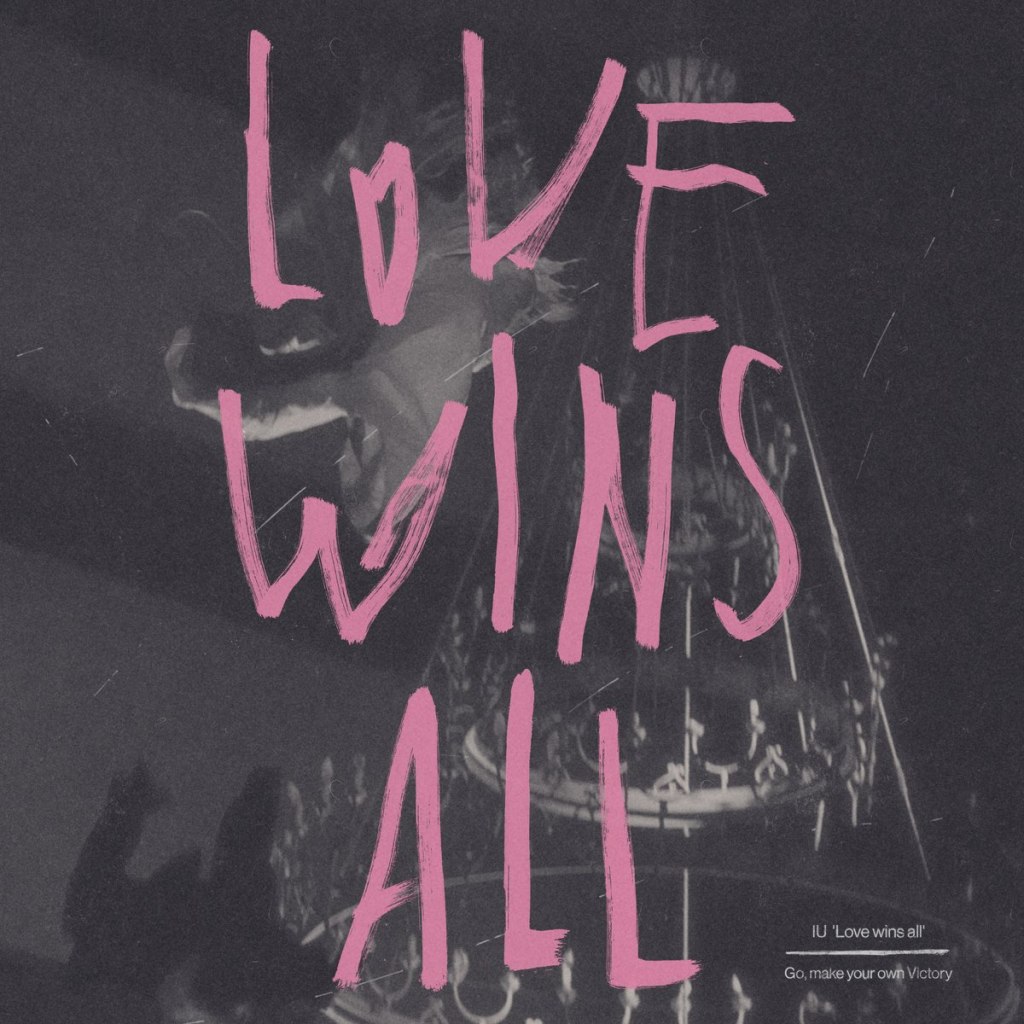
Two days ago, on January 23rd, IU released her new pre-release single “Love Wins All.” Surprisingly, this is not really where the conflict begins. Prior to its release, the song was retitled from “Love Wins” after the LGBT community spoke out about its slogan being co-opted. It was because of this initial controversy that the music video would be under scrutiny. This all laid the foundations for the ableism discourse we are entrenched in now.
According to IATFB’s article on the matter, the controversy is thought to have been sparked by bisexual stylist Nara Kim. Unfortunately, it seems that in the day since this article was uploaded, Kim has edited her Instagram post to remove its original caption and turn off comments. Because of this, I’ll be citing IATFB’s reupload of the post’s caption and the subsequent Instagram stories.
I don’t want to be distorted as a straight and non-disabled person with normalcy through the camera. I’m satisfied with myself #Lovewins #lovewinsall
To which she followed up with this:
The reason why I mentioned this is that the song was initially titled “Love Wins.”
Korean queers, who thought queer’s slogan had been stolen, were furious. There is still controversy after the title of the song was changed and the music video was released.
The two main characters (IU and V) in the music video appear as blind and deaf people who are chased by “discrimination and oppression”.
Different situation from reality shows through camcorder (it means love filter, the director says) and the two appear to be happier (without disability) in this.
I mean, a music video featuring two rich, non-disabled world stars (known as cisgender hetero) uses disabilities, minorities as props to say about overcoming, ending up with a very normal ending of wearing a wedding dress and a tuxedo.
What needs to be overcome is the world, not disability or minorities. Stop the shallow compassion and using minorities as inspirational material
This was met with mixed responses and is an ongoing debate with netizens right now. So let’s examine this.
If you’ve spent some time in the disability studies orbit, you have probably heard of terms like “inspiration porn” or “tragedy porn.” These are terms used to refer to shallow one-note representations of disabled people in media as a method of evoking an emotional response in audiences. I’ve seen some comments accusing the music video of “tragedy porn” specifically, and Nara Kim’s comment is reminiscent of the “inspiration porn” sentiment.
In the ambiguous plot of this music video, IU and V are lovers on the run from a mysterious evil cube thing intent on exterminating them. It chases them through a forest until they find what seems like an abandoned mall to hide out in. IU is portraying a woman who signs and is presumably deaf mute, whereas V’s character is blind in his right eye as a result of injury (made clear by the scar across it). The duo find an old video camera in one of the abandoned shops in the mall- a defunct video store. When V turns it on, he’s shocked to see that when looking through the lens, it portrays the world through seemingly rose-tinted glasses. IU asks what he’s smiling about and he lets her see through the camera, which reveals a version of V where he is not blind. The two then proceed to playfully explore the mall, engaging in an escapist fantasy land where they can eat at a fancy restaurant, find a wedding dress and tuxedo, take wedding pictures in a photobooth, and sing together in front of an audience at what may be a wedding reception. All of the other people in these imagined scenes are wearing black hoods, obscuring their faces, and move in somewhat animated ways. As the couple sing, they hook flowers over each others ears before being interrupted by the cube. The cube snaps them out of their fantasy, springing them back into a world where they are dirty and disheveled. The two flee the cube, running through the mall until they are finally cornered in front of a pile of clothes. IU grabs a big pipe in an attempt at self defense, which V quickly takes from her and uses to attack the cube. The effort is futile, the cube knocking him to the ground. IU quickly catches him, the two watching the cube in fear and beginning to tear up. IU covers V’s healthy eye, leaving him unable to see the cube in his last moments. The video then cuts to a shot of the camera forgotten on the ground, capturing the feet of the two raising into the air through that fantasy lens. The music video ends on a shot of their wedding dress and tuxedo floating down, now joining the big pile of clothes.
Alright, so that’s the raw plot. Now this leaves a few questions; what world is depicted through the camera? What does the cube represent?
Ableism Analysis
The criticisms of this music video ultimately pose two core questions: Is the intended takeaway from this video that disabilities are the problem? And, subsequently, was disability needed to tell this story and get the message across?
Kim, in her Instagram story, describes the music video as depicting the couple running from “discrimination and oppression” in the form of the cube. I’ve seen other interpretations, such as the cube representing the kpop industry itself (insert obligatory cube entertainment HyunDawn joke here). Ultimately, the cube was left as just a cube most likely so that it is more relatable and any hardship a loving couple faces can be projected onto it. I’m sure the director, Um Taehwa, had a big bad in mind when creating this, most likely the always-the-enemy society itself.
Kim mentions the camcorder being “love-vision” according to the director. If this is truly what the director said, there is a point to be made about love supposedly erasing a loved one’s disability. Love distorting the image of a loved one into an abled-bodied version of them is very reminiscent of a common concept in disability studies- the despite.
“I love my son despite his accident.” “I love my wife despite her deafness.” “I love my sister despite her autism.”
Jim Sinclair said it best in his presentation, “Don’t Mourn for Us” (NOTE: this is a link to a PDF of the speech, it will download if you click). When describing the twisted love of despite he said:
Therefore, when parents say,
‘I wish my child did not have autism’,
what they’re really saying is,
‘I wish the autistic child I have did not exist, and I had a different (non-autistic) child instead.’
Read that again. This is what we hear when you mourn over our existence. This is what we hear when you pray for a cure. This is what we know, when you tell us of your fondest hopes and dreams for us: that your greatest wish is that one day we will cease to be, and strangers you can love will move in behind our faces.
The characters IU and V are portraying may not be autistic, but the idea holds true for other disabilities as well. If your love vision erases or otherwise doesn’t recognize a piece of them, it doesn’t love that piece of them. When disability is something so fundamental to the identities of many disabled people, the foundation upon which a whole community has been built, it can often feel that a loved one doesn’t love the disabled person as a whole but instead loves a version of them missing one of their key components.
Kim certainly raises a valid point. But even if this love-vision theory is the case, the ending of the video leaves mixed messages. They live a troubled existence, but can live in an escapist fantasy via their love. That ultimately doesn’t prevail, however, the cube getting them in the end and reducing their wedding clothes to just another pair of garments in a pile of many. So did love really win? They could cope with their circumstances thanks to their love, but it didn’t save them from reality. I suppose when we see them raise from the ground through the camcorder, that is them progressing to the afterlife together, reality unable to separate them.
But what if it wasn’t really love vision? What if it was actually a view of before the apocalypse from the video? What about V’s blindness being the result of presumed violence? The music video was left open-ended initially, so without the added context of the director’s alleged comment, all of these other interpretations are valid.
This brings up a big point of contention in the disability studies sphere: debility vs. disability. How can disability acceptance and celebration take place in the face of those victimized by violence? How do we create space for those harmed to grieve and mourn the results of said violence?
Last fall I read a book by Jasbir K. Puar called The Right to Maim: Debility, Capacity, Disability. Ultimately I came away with the conclusion that these issues are far from black and white and that compassion for others is the golden rule. In a world where so much disability is a direct result of discrimination and violence against marginalized communities, we can acknowledge the harm done by and denounce this violence. To be intersectional, in fact, we must denounce this violence. We can also have an understanding of disability as not inherently bad. Disability can be both a result of a traumatic event and simply a natural way of being for someone else born with the disability. Disability can be a lot of things to a lot of people. The problem comes when you make disability a monolith of tragedy, but we cannot pretend disability is all roses and sunshine either.
IU and V’s characters missing a past where he was unharmed and she could sing is entirely understandable. A time before violence changed the bodies they knew and had as home. In this reading of the story, it’s the world around the couple that is the problem. The message the ending delivers in this reading is less about the couple itself and more about the cube targeting them, demonstrating how damaging it is.
The only hole in this version is that if it were just a version of them before the apocalypse, the ending with their feet floating up in the air seems a bit out of place. If I were to direct this with that storyline, I’d instead have included a shot of them hugging happily through the lens reflecting that happier time. The feet floating could, however, just be a euphemism for their passing that wasn’t thought through much, because I don’t think Um Taehwa put super intense thought into this three minute music video in case someone like me came around to question the in-universe laws of a magic camcorder.
The question as to whether disability was a necessary component to tell this story is an important one that has no right answer. It depends on what the message was meant to be, and it’s intentionally left open-ended, so there’s not really a way to argue that the inclusion of disability to the plot was justifiable.
But what about the disability positive aspects?
The scene in which IU covers V’s seeing eye in an effort to reduce his suffering served to pose his blindness as positive. That she didn’t even have to cover his other eye was an upside in that moment. I felt it was this scene that really redeemed this music video for me, even if it’s a relatively minor detail.
There’s also something to be said about resiliency and growing through disability. The couple seem very in tune with each other, communicating in sign and lip-reading. They have worked hard to accommodate each other and learn to communicate in new ways. I always love seeing different methods of communication and interaction between people on screen, because it reflects one of the beautiful aspects of the disability experience and community (from my perspective). It warms my heart as someone who communicates with my autistic younger sister in unconventional ways to see that reflected on screen (and not in a ‘those freaky twins speaking their own language’ way, but in a ‘a special bond between us’ way).
Final Verdict
It’s a flawed piece of art like any other, that may further the tragedy porn trope. But to reduce the story to only that would be a bit unfair. The depiction of disability here is admittedly a mixed bag, but there’s some good thrown in there too. There is an important discussion to be had about these topics and ultimately the music video bringing them to the spotlight of the kpop sphere is a particular blessing as the community doesn’t talk disability very much.
If you’ve read all the way to the end, I thank you very much for caring about disability topics enough to engage with this!
And to finish this off with a little additional disability positivity, shout out to the KSL interpreter credited on the project, Cho Yeonjae! Thank you for your work to help depict sign accurately!

 Rocker Kpop
Leave a comment